Menopause at work now has an international standard. ISO 45010:2026, published in September 2026, gives organizations of any size or sector guidance on supporting workers through menstruation and menopause.
For Canadian employers this is welcome news. It is voluntary, it is practical, and it gives HR leaders a shared yardstick for work many of them are already doing.
What is an ISO standard?
ISO is a worldwide federation of national standards bodies. Experts from many countries agree on good practice and publish it as a standard. Think of it as a shared recipe. Nobody is forced to follow it, but it gives everyone the same way to measure how they are doing. Canada’s member is the Standards Council of Canada.
What ISO 45010 Menopause Guidance Covers
The standard gives guidance on developing policies and practices that support workers’ menstrual and menopausal health. It applies to any organization, whatever its size or sector. It is not medical guidance, and it does not cover andropause, although its authors note that many recommendations can also support workers going through it. You can read its scope, introduction and contents list free of charge on ISO’s browsing platform.
Its tone is respectful and balanced. It describes menstruation and menopause as life course experiences, not medical conditions, and recognizes that many workers manage them privately without extra support. For those who want it, adjustments, supportive policies and open conversation reduce stigma. It uses the word menopause for the whole transition, which includes perimenopause, menopause and postmenopause.
| Heading in the standard | What the heading points to |
|---|---|
| Physical aspects of work | The work environment |
| Policy guidance and practice | Policies that include menstruation and menopause |
| Supportive workplace cultures | Openness and reduced stigma |
| Job design | How work is organized |
| Disclosure and privacy | Confidential conversations |
| Inclusivity | Different experiences, including intersecting factors |
| Small and medium-sized enterprises | Cost effective steps for smaller employers |
| Evaluation and metrics | Checking what is working |
| Annexes | Manager toolkit, sample internal review checklist, recruitment considerations |
The introduction lists the benefits for organizations: stronger worker engagement, better retention, lower attrition and recruitment costs, more aware leaders, and help meeting occupational health expectations from suppliers and buyers. It sits alongside ISO 45001 on occupational health and safety and ISO 53800 on gender equality, so menopause is treated like other workplace health topics.
Where ISO 45010 Menopause Guidance Comes From
The UK got there first. The British Standards Institution launched BS 30416 in 2023 as a free resource for any organization, with guidance on culture, training for managers and HR, the physical environment, policy review and flexible work design. The ISO 45010 menopause standard brings this kind of guidance to the international level, which gives Canadian employers a common reference point.
What It Means in Canada
ISO 45010 menopause guidance is voluntary, so it changes no law. Employee rights in Canada still come from human rights legislation. In Ontario, the Human Rights Commission explains that employers must accommodate disability to the point of undue hardship and be alert to needs even without a formal request. Its guidance on that duty does not mention menopause, which is where practical guidance like ISO 45010 can help.
Canada already has a strong starting point. The Canadian Centre for Occupational Health and Safety lists 15 employer actions, updated in October 2026. They include training all employees to talk about menopause without stigma, flexible hours that cover medical appointments, some control over temperature and ventilation, regular access to toilets and cool drinking water, and attention to fatigue in shift schedules. ISO 45010 and CCOHS point in the same direction.
My suggestion
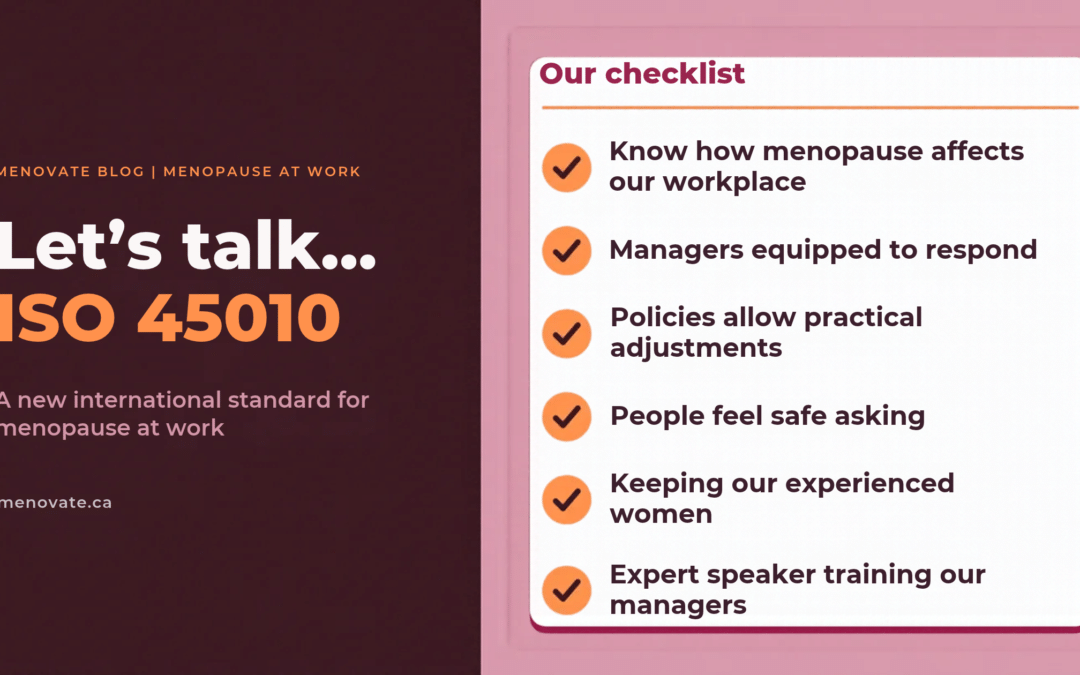
I suggest using ISO 45010 as a checklist, not a certificate. Walk through its headings and ask six questions. Do we know how menopause affects our workplace? Are our managers equipped to respond? Do our policies allow practical adjustments? Do people feel safe asking? Are we keeping our experienced women? Have we brought in an expert speaker to educate and train our managers? Many useful adjustments are simple, and the answers show where to start.
What You Can Do This Week
Read the free sections of ISO 45010 and the CCOHS fact sheet. Pick three headings where your workplace can improve this quarter. Brief your managers on one change, such as flexible start times or temperature control. Then ask your employees what would help most. A policy is only as strong as the conversations around it, and that is the work I do with employers at Menovate.
I am not a lawyer or a doctor. This post is not legal advice, and you should talk to your own doctor before starting, stopping or changing any medication.
Aimee Debow is the Founder of Menovate and a certified Menopause Coach. She appeared as a witness before the House of Commons Standing Committee on the Status of Women in June 2026. Menovate helps Canadian organizations build menopause-supportive workplaces through corporate talks, e-learning, and HR advisory services. Learn more at menovate.ca.